
Calendar Search Results: u i a song
August 22, 1957 Country singer-songwriter Holly Dunn is born in San Antonio, Texas.
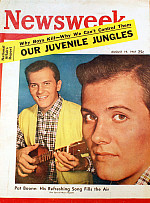 August 19, 1957 In a "Special Music Report," Newsweek puts Pat Boone on the cover with the tagline, "His Refreshing Song Fills The Air."More
August 18, 1957 Ron Strykert (lead guitarist for Men at Work) is born in Victoria, Australia.
August 15, 1957 Notorious Californian groupie Sable Starr is born. As well as counting Alice Cooper, Rod Stewart and David Bowie among her conquests, she is the muse for Iggy Pop's 1996 song "Look Away."
August 12, 1957 Encouraged by Roulette exec George Goldner and his recent success in England, Frankie Lymon officially leaves his group to pursue a solo career.
August 7, 1957 The Quarrymen (minus new member Paul McCartney, away at Scout camp) make their debut at Liverpool's Cavern Club. Manager Alan Sytner instructs them not to play Rock and Roll, but midway through their skiffle performance, John lights into a version of Elvis' "Don't Be Cruel," which the crowd loves. The group, of course, becomes The Beatles.
August 7, 1957 Paul Anka makes his US television debut, singing "Diana" on American Bandstand.
August 5, 1957 American Bandstand goes national when it airs for the first time on ABC. The show will run for five years on the Philadelphia TV station WFIL as Bandstand. Hosted by Dick Clark throughout its national run, the show remains on network TV until 1987. The first song the kids dance to this day is "That'll Be The Day" by Buddy Holly.
August 4, 1957 The Everly Brothers perform "Wake Up Little Susie" on the Ed Sullivan Show. It is one of the more controversial songs ever played on the show, as there are some questions as to what Susie and her date were doing before she fell asleep.
July 31, 1957 Daniel Ash (guitarist for Bauhaus, Love and Rockets) is born in Northampton, England.
July 24, 1957 Pat Boone makes his acting debut in the musical comedy Bernardine. The movie also features his hit songs "Love Letters In The Sand" and "Bernardine."
July 9, 1957 Marc Almond is born Peter Mark Sinclair Almond in Southport, Lancashire, England. In 1979 he teams with Dave Ball to form Soft Cell, a boundary-pushing electronic duo that have a global hit in 1981 with their cover of "Tainted Love." In 1989, Almond lands a #1 UK hit with "Something's Gotten Hold Of My Heart," a duet with Gene Pitney.
June 24, 1957 Terence "Astro" Wilson (percussionist, trumpet player for UB40) is born in Birmingham, England.
June 5, 1957 Bill Justis records the instrumental hit "Raunchy."
June 3, 1957 Pat Boone's "Love Letters In The Sand" hits #1 on the US Top 100 and stays for seven weeks. Boone would have two of the Top 5 songs of 1957 ("April Love" is the other), while Elvis has the other three.
May 27, 1957 Siouxsie Sioux (lead singer for Siouxsie and the Banshees) is born Susan Janet Ballion in London, England.
May 18, 1957 Electronic musician Michael Cretu (of Enigma) is born in Bucharest, Romania.
May 10, 1957 Sid Vicious (bassist for The Sex Pistols) is born John Simon Ritchie in Lewisham, London, England.
May 4, 1957 Alan Freed's Rock and Roll Revue debuts on ABC; the show is an attempt to replicate the success of their own hit American Bandstand. The first show features performances from The Clovers, The Del-Vikings, Screamin' Jay Hawkins, Sal Mineo, and Guy Mitchell.
May 1, 1957 The first issue of 16 Magazine, featuring Elvis Presley on the cover, is published.
April 29, 1957 Great White guitarist Mark Kendall is born in Loma Linda, California. A primary songwriter in the band, he keeps it going in the 2010s and 2020s when it competes with Jack Russell's Great White, the offshoot led by the group's longtime frontman.
April 13, 1957 Elvis Presley lands his seventh #1 hit in America with "All Shook Up." It spends nine weeks at the top of the chart, more than any other song in 1957.
April 12, 1957 Country singer Vince Gill is born in Norman, Oklahoma.
April 11, 1957 Jim Lauderdale is born in Trautman, North Carolina. The Americana icon earns a reputation as a songwriter's songwriter in Nashville, where he writes popular songs for George Strait ("The King Of Broken Hearts"), Patty Loveless ("Halfway Down"), Vince Gill ("Sparkle"), and The Chicks ("Hole In My Head"), in addition to recording his own material. His longtime partnership with Grateful Dead lyricist Robert Hunter results in over 100 songs, including "Memory," a ballad completed mere months before Hunter's death.
April 10, 1957 Bass guitarist Steve Gustafson (of 10,000 Maniacs) is born in Seville, Spain.
April 10, 1957 Ricky Nelson, 16, performs his first single, a cover of Fats Domino's "I'm Walking," on The Adventures of Ozzie and Harriet, the TV series he stars in alongside his real-life family. The song quickly climbs the charts and launches his music career.
March 31, 1957 Sun Records stars Johnny Cash and Carl Perkins begin a tour of the South in Little Rock, Arkansas, with Jerry Lee Lewis as a support act.
March 28, 1957 Ral Donner, later to hit with the Elvis-soundalike "The Girl Of My Friend," sees Elvis for the first time, performing at the International Amphitheater in Chicago.
March 27, 1957 "Whatever Will Be, Will Be (Que Sera)" from the Alfred Hitchcock movie The Man Who Knew Too Much wins the Academy Award for Best Original Song.
February 13, 1957 Tony Butler (bassist for Big Country) is born in Shepherd's Bush, London, England.
©2026 Songfacts®, LLC