
Timeline : Bob Dylan
Bob Dylan appears on The Steve Allen Show. He gives a brief, awkward interview before performing "The Lonesome Death Of Hattie Carroll."
The Beatles smoke pot for the first time, supplied by Bob Dylan, who joins the band after one of their concerts in New York state. Dylan is surprised they haven't tried it before, as he thought they sang "I get high" in their song "I Want To Hold Your Hand," when it was really "I can't hide."
It's the heyday of the harmonica, as the industry publication Billboard points out that The Beatles, Bob Dylan, The Rolling Stones and Stevie Wonder have all had hits with the instrument.
Bob Dylan records "Maggie's Farm" in Studio A at Columbia Recording Studios.
Bob Dylan records "Farewell, Angelina," a landmark song in the evolution of his surrealist songwriting process. The recording, however, doesn't see the light of day until it's released on The Bootleg Series Volume 1-3: Rare & Unreleased over 25 years later.
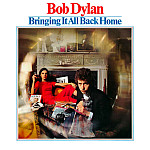
Bob Dylan releases his fifth album, Bringing It All Back Home.
Bob Dylan begins the tour immortalized in the documentary Don't Look Back, performing at the City Hall in Sheffield, England.
The Byrds release their cover of Bob Dylan's "Mr. Tambourine Man." It's their first single and a huge hit, going to #1 in June.
Bob Dylan's second album, The Freewheelin' Bob Dylan, goes to #1 in the UK. It's the first time an artist other than The Beatles or The Rolling Stones has topped the chart since the Summer Holiday soundtrack on April 28, 1963.
 D.A. Pennebaker films Bob Dylan in one of the earliest music videos ever shot, the famous "flashcard" clip for "Subterranean Homesick Blues."More
The Byrds' "Mr. Tambourine Man" goes to #1 on the Hot 100. It's the only song written by Bob Dylan ever to top that chart.
At Columbia Studios in New York City, Bob Dylan finishes recording "Like A Rolling Stone," a song about a socialite who falls from grace. The Hammond organ comes courtesy of Al Kooper, who later forms Blood, Sweat & Tears.
Bob Dylan charts for the first time as an artist in the US when "Like A Rolling Stone" enters at #91. A handful of his songs have already been hits as covered by other artists, most notably the 1963 Peter, Paul and Mary version of "Blowin' In The Wind."
Bob Dylan releases "Like A Rolling Stone." At 6:13, it's twice as long as the average pop song, but it nonetheless becomes Dylan's first big hit and one of his most popular songs.
Bob Dylan plays "Desolation Row" for the first time at the Forest Hills Music Festival in Queens, New York.
Bob Dylan marries his first wife, Sara Lownds, in Nassau County, New York; as she is already pregnant with his first child, the marriage is kept a secret for the next two months. The couple would divorce in 1977.
Bob Dylan, who has recently "gone electric" and added rock and roll instruments to his folk music, appears at the Free Trade Hall in Manchester, England. Just before he begins a version of his latest hit, "Like A Rolling Stone," a member of the audience, a folk purist angry at the move to rock, shouts out, "Judas!" Dylan responds with, "I don't believe you," adding, "You're a liar!" He then proceeds to tell the band to play the song "f--king loud."

Bob Dylan gets in a motorcycle accident near Woodstock, New York, and pretty much disappears for nine months, leaving a void filled with rumors speculating on his condition. He clears things up in his 2004 autobiography, where he writes: "I had been in a motorcycle accident and I'd been hurt, but I recovered. Truth was that I wanted to get out of the rat race."
The acclaimed Bob Dylan documentary Don't Look Back premieres at the Presidio Theatre in San Francisco. Directed by D. A. Pennebaker, it follows Dylan on his 1965 European tour.
Bob Dylan records "All Along the Watchtower," later made famous in a cover by Jimi Hendrix. He also bangs out "John Wesley Harding," "As I Went Out One Morning," "I Pity The Poor Immigrant" and "I Am A Lonesome Hobo" at the sessions.
Bob Dylan releases his eighth album, John Wesley Harding, featuring the classic tune "All Along the Watchtower." The Jimi Hendrix Experience later covers the song, which becomes the band's biggest US hit, peaking at #20 in October 1968.
Roughly three months after the death of Woody Guthrie, a tribute concert is put on in the folk hero's name by Bob Dylan, Pete Seeger, The Band, Ramblin' Jack Elliott, Tom Paxton, Judy Collins, Arlo Guthrie, Odetta, and Richie Havens at Carnegie Hall in New York City.
Bob Dylan and Johnny Cash record some duets in Nashville, with "Girl From The North Country" eventually ending up on Dylan's Nashville Skyline album, for which Cash writes liner notes.
Bob Dylan stuns fans and critics alike by releasing Nashville Skyline, a country album sung in an entirely different voice from the one Dylan has been using.
It's the first day of the two-day Isle of Wight Festival. Performers include Bob Dylan, The Moody Blues and The Who. This is the second Isle of Wight Festival - it goes on again next year, but doesn't return until 2002.
On the day Woodstock begins, Bob Dylan sails on the Queen Elizabeth 2 for the Isle of Wight in England. Fed up with the "druggies" who'd been showing up at his house at all hours, he wants nothing to do with Woodstock and opts instead to perform at the Isle of Wight Festival two weeks later.
©2026 Songfacts®, LLC